Monday, February 17, 2014

Payments Innovations Replace Debit and Credit Cards

PAYMENTS STRATEGY


At a time when payment innovation seems like an everyday occurrence, it is exciting when new ideas come along that embrace both mobility and simplicity. In separate personal user tests, LoopPay allows me to make contactless payments at virtually every retail point-of-sale terminal while Square Cash enables me to collect money from friends with an email.


Here's why I no longer need a wallet filled with plastic.


When I initially covered these payments innovations in late 2013, both LoopPay and Square Cash drew my attention because of their unique strategies to impact the way people make payments. LoopPay promised to deliver a device that would 'trick' a traditional POS terminal into thinking a card was being used, making virtually every transaction contactless. Square Cash provided a secure method of making P2P payments via email. LoopPay's value proposition was to provide an easier and more secure way to pay merchants while Square Cash aimed to simplify P2P transactions.

Loop Wallet


Several weeks ago, I received my Loop Fob, the first in a series of Loop Wallet 'AppCessories' that would allow me to securely store and organize my payment, loyalty and gift cards in my iPhone while making contactless payments at more than 90% of today's terminals worldwide.

My first impression when I received my Loop Fob was that, while the packaging was very well done and provided a clear overview of what was needed to use the device, the device was larger than I anticipated. Once I began to use the device, however, I found the fob to be convenient while serving to whet my appetite for the soon to be released iPhone ChargeCase.
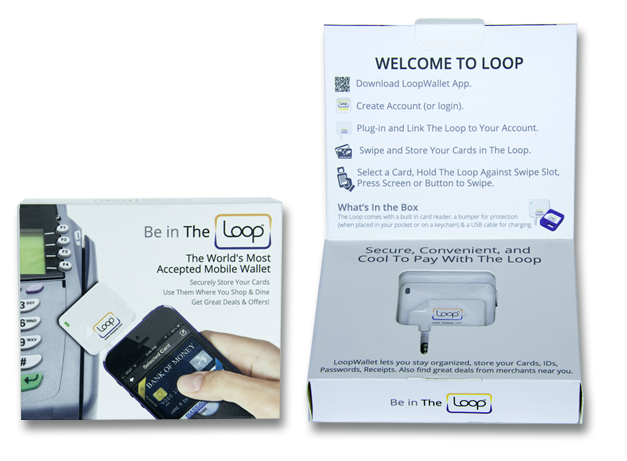
The Loop Fob Wallet AppCessory Packaging

Loop Wallet Set-Up

Once I downloaded the LoopWallet application from the iPhone store (Android version to be introduced shortly), I simply signed-up for the service and answered a series of security questions within the app. The securitization was complete after I entered an activation token that was sent to my connected email account.

Loading my cards was done using the card reading component of the fob while the fob was connected to my iPhone. A nice feature of the scanning process was the optional feature of adding a picture of my cards, the customer service phone numbers for for each card and an example of my signature. I could also add gift and loyalty cards as well as my drivers license to be part of my Loop Wallet. 

The last step of the initialization process was to designate a default card that would be used when the fob is disconnected from my phone (the majority of my transactions have been with the fob disconnected). The default card can be changed at any time when the fob is connected to the phone. The tutorial below was a great way to understand the application process and usage of the Loop Fob.

Wednesday, February 12, 2014

Tomorrow's Checking: Built For The Mobile-First Consumer

PRODUCT STRATEGIES


The checking account is the foundation of a customer relationship and has withstood the test of time even as electronic payments and debit cards have replaced checks, online banking has eliminated the need for paper statements and remote deposit capture has made a trip to the branch a rare occurrence.


But all that we have become accustomed to is about to change as we enter the era of the downloadable bank account.


The downloadable bank account differs from today's checking account because it is built specifically for Customer 3.0. This customer manages much of their life on the go from their smartphone, wants access to real-time information about their finances and wants the ability to transact business without checks or plastic. They are the type of customer who pays for their coffee with their Starbucks mobile app, and uses mobile deposit capture instead of going into the bank or credit union branch.

Tomorrow's checking is not just having mobile access to a traditional checking account. It is a bank account built for mobile.

It is a downloadable mobile banking application that provides the basic money storage and money management capabilities of today's checking as well as integrated payments, contextual insight and an overall customer experience not being provided by traditional financial institutions today. It is easy to open and manage using a mobile device, and is similar to the products offered by Moven, Simple GoBank, Bluebird in the U.S. and mBank, FidorHello, CommBank and Soon overseas. Tomorrow's checking may not have any associated plastic card, but may be able to store alternative currencies as was recently announced by Standard Bank.

Both Moven and Simple Provide Exceptional
Mobile Banking Contextual Insights

While the traditional checking account may not completely go away anytime soon, the risk of not meeting the needs of the mobile-first customer is increasing. This is because more new players are entering the marketplace such as T-Mobile's Mobile Money, with the potential of providing a downloadable bank account to a much broader audience than just the underbanked, unbanked and debanked. With either an already established physical presence or no bricks and mortar, these services can be provided at a lower cost than traditional banks.

Combining the attributes of a prepaid card and a traditional checking account, new checking disruptors can provide FDIC insurance, the ability to make direct deposits and electronic payments, accessibility to nationwide surcharge-free ATMs, mobile deposit capture and even branch access, checks and integrated rewards.

Attacking on a different front, players such as Google, PayPal, Amazon, Apple, Isis and others are hoping to control the digital wallet processing component of the payments ecosystem, leaving traditional banks with only depository functions.

Wednesday, February 5, 2014

Banks Can't Close Branches Fast Enough

BRANCH STRATEGIES


U.S. banks are closing branches in record numbers as customers are increasing their use of mobile and online banking. Yet, in conversations with seven of the nation's top ten banks, many more branches would be closed if there wasn't concern for public or governmental backlash.


Do banks have an obligation to keep branches open, or will the need to cut costs drive an accelerated wave of new closures?


According to SNL Financial, banks closed a net 1,487 branches last year. That's the highest number of net closures since the research firm began tracking the statistic in 2002. The majority of these closures have been attributed to the increasing use of online and mobile banking as technology enables consumers to manage their accounts, make remote deposits and shop for services more efficiently from desktops or smartphones.


Despite these closures, the number of bank branches in the U.S. still hovers above 80,000 according to the FDIC, making the U.S. one of the highest branched countries per capita in the world. That is why, in an era of sluggish revenue growth and heavy compliance costs, most bankers are trying to close or reconfigure underperforming branches as quickly as possible.


But closing branches involves more than just locking the doors and informing customers of other banking and branching options. In conversations with banking executives from seven of the largest banks in the country, I was told that between 50 percent and 80 percent of all branches that should be closed based on financial considerations are not closed due to potential regulatory or public relations repercussions. With many analysts saying that 25-30% of all branches are unprofitable, this could represent a 'backlog' of well over 10,000 branches nationwide.

In my discussions with these banks, it was mentioned that many of the branches that are not carrying their weight from a revenue perspective are either in lower income markets or in small rural areas where access to an alternative nearby physical location may be limited. This creates a unique dichotomy between a prudent financial decision and the desire to maintain trust and goodwill lost during the financial crisis.

When I asked whether reconfiguring these underperforming branches was an option, many of the executives I contacted said that they were even concerned about negative reaction to replacing tellers with automated kiosks or moving to smaller physical footprint locations. Said one banker, "We're caught between a rock and a hard place with many of the closings we would like to do. The decreasing number of transactions at many of these offices makes them highly unprofitable, but moving to an automated model brings its own issues."

The perceived obligation to keep branches open, and the real estate related costs of closing branches, may explain the rather conservative rate of branch closures to date despite branch transaction volumes that continue to plummet and costs that continue to rise. The same challenge is being faced by banks worldwide, evidenced by a recent U.K. article in The Telegraph asking, 'Do Banks Have a Duty to Keep Branches Open?' Interestingly, more than half the people who responded did not believe banks should be required to keep unprofitable branches open.

Telegraph (UK) Consumer Survey (2014)

Wednesday, January 29, 2014

Simplicity In Banking Is Anything But Simple

CUSTOMER EXPERIENCE


It's time to build your simplicity capability.


Financial institutions are starting to realize that simplicity does not only improve the customer experience, resulting in trust and loyalty, but also reduces operational costs from redundant products, processes and dealing with customer complaints.


By Jin Zwicky, VP Experience Design, OCBC Bank, Singapore


How can banks achieve simplicity?

We can find great lessons from smart banking alternatives such as Simple, Moven, GoBank and Bluebird. What is less discussed is how to achieve simplicity in traditional banks that deal with a legacy of old processes, infrastructure and often don’t have luxury of starting afresh. Translating the big intent to achieve simplicity into realization is not easy.

The good news is that realizing simplicity is possible in any bank. As a design practitioner in one of the largest banks in Singapore, I’ve been leading a broad range of ‘Simplicity’ initiatives in the bank, such as website design, mobile banking, advisory tools, investment product communications as well as redesigning physical spaces. All of these initiatives have reaped measurable success in bottom line results and operational efficiency.

We saw double-digit increases in sales in investment and insurance products when we simplified the communications material. We saw 100% adoption rate in using the digital needs analysis tool in our top branches after we simplified the tool. We increased customers’ satisfaction in our account opening experience by simplifying the system. Finally, our simplified website was not only listed as The More Gorgeous and Simple Banking Website, but also we could save about 0.5 million dollars per year by reducing the number of pages in the website.

From years of my simplicity journey, I came to believe that ‘simplicity’ is not just a project. It is not just a team of simplicity specialists. It is a capability that we have to cultivate! Furthermore, it is an organizational culture that we have to create in order to achieve simplicity.

I came up with the following framework to illustrate this point.


Sunday, January 26, 2014

How Will Banks Respond if Apple Becomes Mobile Payments Player

MOBILE STRATEGIES

According to a report in the Wall Street Journal, Apple is gearing up to roll out a new payments system for physical goods and services beyond the walls of it's Apple stores.

If true, Apple would leverage the iTunes payments system, credit card data already on file for more than a half million consumers, and recent patents to become a big player overnight.

How will banks or credit unions respond? 


A new report claims that Apple’s senior vice president of Internet Software and Services, Eddy Cue, “has met with industry executives to discuss Apple’s interest in handling payments for physical goods and services on its devices, according to people familiar with the situation.” The paper also said that online store boss Jennifer Bailey has been re-assigned to a new role where she’s tasked with growing a payment service at Apple.

According to the Wall Street Journal, Apple also spoke to at least five other well-known executives in the payment industry about the position before tapping Ms. Bailey.

These moves come just months after Apple installed new iBeacon payments technology in their stores and allowed for the payment of smaller ticket store items using the iPhone app and without the need to interact with a store employee.

Obviously, if Apple does enter the mobile payments space, they would not be alone. Mobile payments is a highly competitive industry which has yet to develop a uniform standard due to the lack of tangible benefits to the consumer, the processor and the merchant. This hasn't deterred the likes of PayPal, Google, Square, Stripe, Visa, Mastercard and American Express from developing their own mobile payment platforms however.

While a solution from Apple may not require major changes from the customer or merchant as NFC or EMV does, Apple would still need to improve their position as a 'trusted payments partner' beyond what was found in a 2013 Oglivy and Mather's Mobile Shopper survey shown below.


Note: 'Trust' of Apple as a payments provider was much higher for current Apple customers and many consumers didn't view Apple as a payments player at the time of the research.

According to Denee Carrington, analyst at Forrester Research, "Apple is absolutely the sleeping giant in the payments world. They have the capability... they just haven't tied it all together."

Why Enter Mobile Payments


Why would Apple enter the mobile payments battlefield?

First of all, mobile payments is BIG business. According to Forrester Research, 31% of US online consumers who own a mobile phone are interested in or already use mobile payments for in-store purchases, up from 18% in 2011. However, while 61% of US consumers have heard of a digital wallet, only 11% use one.

But that is expected to change. Americans are expected to spend $90 billion through mobile payments by 2017, up from $12.8 billion in 2012, according to Forrester.

Secondly, current payments infrastructure is outdated. As can be seen from the recent data hacking done at Target, Neiman Marcus, Michael's and probably elsewhere, debit and credit cards are inherently insecure. And since most cards in the U.S. still use outdated magnetic stripes as opposed to EMV technology, personal data is relatively easy to steal.

Thirdly, each card in your wallet represents access to an account without real time insight or interface. A mobile-first payment application similar to what is offered by progressive financial institutions like Moven, Simple, and several banks overseas is a much better way to make payments. They allow you to see what is happening with your account in real time, provide instantaneous receipts, allow for interactive money management and have the potential to be more secure.

Lastly, similar to what banks do today, processing payments with a mobile device could enable Apple to charge a nominal processing fee, but more importantly, gather deep payments and behavioral data from customers and build even more brand loyalty.