Showing posts with label Square. Show all posts

Monday, February 17, 2014

Payments Innovations Replace Debit and Credit Cards

PAYMENTS STRATEGY


At a time when payment innovation seems like an everyday occurrence, it is exciting when new ideas come along that embrace both mobility and simplicity. In separate personal user tests, LoopPay allows me to make contactless payments at virtually every retail point-of-sale terminal while Square Cash enables me to collect money from friends with an email.


Here's why I no longer need a wallet filled with plastic.


When I initially covered these payments innovations in late 2013, both LoopPay and Square Cash drew my attention because of their unique strategies to impact the way people make payments. LoopPay promised to deliver a device that would 'trick' a traditional POS terminal into thinking a card was being used, making virtually every transaction contactless. Square Cash provided a secure method of making P2P payments via email. LoopPay's value proposition was to provide an easier and more secure way to pay merchants while Square Cash aimed to simplify P2P transactions.

Loop Wallet


Several weeks ago, I received my Loop Fob, the first in a series of Loop Wallet 'AppCessories' that would allow me to securely store and organize my payment, loyalty and gift cards in my iPhone while making contactless payments at more than 90% of today's terminals worldwide.

My first impression when I received my Loop Fob was that, while the packaging was very well done and provided a clear overview of what was needed to use the device, the device was larger than I anticipated. Once I began to use the device, however, I found the fob to be convenient while serving to whet my appetite for the soon to be released iPhone ChargeCase.
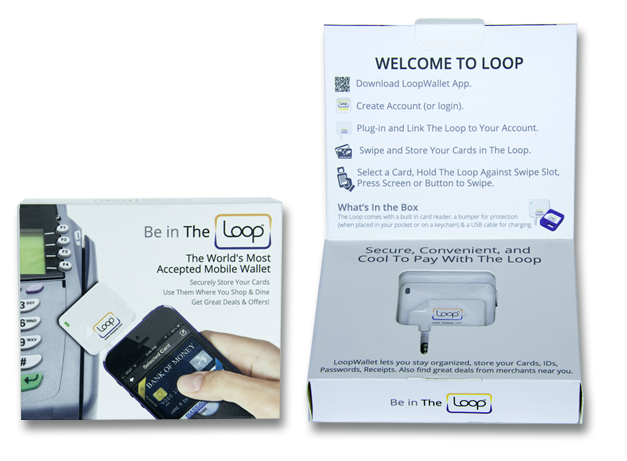
The Loop Fob Wallet AppCessory Packaging

Loop Wallet Set-Up

Once I downloaded the LoopWallet application from the iPhone store (Android version to be introduced shortly), I simply signed-up for the service and answered a series of security questions within the app. The securitization was complete after I entered an activation token that was sent to my connected email account.

Loading my cards was done using the card reading component of the fob while the fob was connected to my iPhone. A nice feature of the scanning process was the optional feature of adding a picture of my cards, the customer service phone numbers for for each card and an example of my signature. I could also add gift and loyalty cards as well as my drivers license to be part of my Loop Wallet. 

The last step of the initialization process was to designate a default card that would be used when the fob is disconnected from my phone (the majority of my transactions have been with the fob disconnected). The default card can be changed at any time when the fob is connected to the phone. The tutorial below was a great way to understand the application process and usage of the Loop Fob.

Friday, November 15, 2013

Big Day for Payments: Plastic vs. Digital

Only in the ever changing world of payments.


It is more than a bit ironic that on a day that Isis Mobile Wallet announced that they were going live with their carrier-backed digital payments initiative, a unique card-based solution named Coin announced their alternative solution to the overstuffed wallet.


The question is . . . which solution has the greatest chance for near-term and long-term success?


Maybe both will garner the support of the key involved parties. Maybe neither. Maybe another company will take the Coin concept mainstream sooner than the planned introduction. The one thing I am pretty sure of is that it is further evidence that financial institutions need to place multiple bets on alternative solutions to avoid being left behind.

Despite all of the talk in the industry around mobile payments, acceptance of new digital innovations and platforms has been anything but a smooth ride. In addition to the seemingly insurmountable challenge around consumer's concern with security/privacy, getting merchants, consumers, financial institutions and even carriers on the same page has been close to impossible.

At the end of the day, the biggest challenge may be the perception by many that there is no reason to fix something that isn't broken. The current card-based process for making payments, while not perfect, is relatively easy and definitely firmly entrenched in the consumer's daily life.

What is Coin?


Coin is a .84 mm thin plastic card-like device that can store any of your current cards (actually, 8 of them) and behave like the cards it replaces. Instead of carrying an assortment of debit, credit, gift, membership and loyalty cards from various institutions, you simply use the dongle provided (like the one used by merchants accepting Square) to capture your card information on your phone, take a picture of the cards and use the Coin app to load your Coin card.

While only 8 cards can be loaded into the Coin card, an unlimited number of cards can be stored in the mobile app and switched in and out of the card as desired. "You don't need eight cards every day, so your phone is kind of like your drawer, and your Coin is kind of like your wallet," explains Parashar, founder and CEO of Coin. 

When you are ready to pay or use a loaded card, simply press a button on your Coin card to select the card you want to use (electronics imbedded within the Coin card itself), present your card to the merchant like you have done in the past, and the rest of the process is the same as it is today (see compelling video below).


Coin is Secure


For those concerned about the security of the card should you leave the card behind (only happens to me about 4x a year), the Coin card uses Bluetooth low energy technology to inform you on your phone that you left your card behind. Better yet, the card completely disables itself if your phone and card are away from each other for more than 10 minutes. 

For those concerned about someone scanning another person's plastic into the app, Coin says that the app only accepts a card that includes the user's personal information. Further, the Coin app is protected with 128-bit or 256-bit encryption and the company is pursuing PCI compliance. The app is also password protected.

Wednesday, October 30, 2013

Mobile Payments Growth: Just The Tip of The Iceberg?

A new report from Business Insider Intelligence on the state of the mobile payments industry shows that, while the volume of mobile payment transactions still represent just a small percentage of overall payments on the surface, the level of growth is significant and quickly shaping the entire payments industry.


Both consumer and merchant uptake is exploding as smartphone users are quickly adopting mobile wallets, payment apps, etc. to facilitate offline and online purchases and as businesses are turning smartphones and tablets into full-featured POS terminals. The next critical step is to persuade the masses to become users of the payment technology available.


When Amazon and eBay launched their online shopping sites in 1995 and 1996 respectively, the notion that over half the U.S. population would make purchases online would have been scoffed at. Yet in 2013, the number of online shoppers in the U.S. will reach 189.6 million, according to eMarketer. In this case, the majority of the consumers were resistant to change until they made the switch and realized the benefits. The same applies to mobile payments.

The key is to examine the current payments industry growth trends, motivations of current users, the reasons for the gap between awareness and usage, and how financial institutions, retailers, network operators and equipment manufacturers can work together to convert reluctant consumers into loyal users. As mentioned by many of my fintech colleagues recently, it goes beyond a mentality of "If you build it, they will come". There is a need to solve for the concern around mobile security as well as develop incentives for usage.

Defining Mobile Payments


For the purpose of the study being reviewed, 'mobile payments' were defined as when a mobile, internet-connected device (smartphone, tablet, smart watch, Google Glass, etc.) is used to facilitate a transaction that might otherwise have taken place using a physical credit card, debit card, check or cash at a physical (not online) store. 'Mobile transactions' (for the purpose of this study) are a larger category that included mobile payments as well as mobile commerce and e-commerce channeled by an app or mobile website (e.g., Amazon's mobile app).

Mobile payments and transaction innovation is currently be led by start-ups and tech companies, who are prompting legacy payments players and card companies to reevaluate their current strategies and increase their own pace of innovation. 'Coopetition' has become the norm as companies team up with each other as opposed to building a mobile strategy from scratch. These partnerships (and individual initiatives) are pushing innovation forward quickly, making the industry fragmented yet ripe for consolidation.

Mobile Payments: Still Relatively Small on the Surface


Like an iceberg, there is much more to the mobile payments than what the can be seen on the surface today, with a U.S. mobile payments forecast of $30 billion in 2013. According to the research compiled by BI Intelligence, this forecast represents an average annual growth rate of 118 percent since 2008, but still will only account for 2 percent of the $3.3 trillion debit and credit card volume in the U.S. this year. It was also found that other global markets (such as Africa and the Asia Pacific regions) are seeing a much larger percentage of mobile transactions.

In both the U.S. and other global regions, the growth in mobile transaction volume has been driven primarily by the growth in smartphone adoption (especially in areas of underdeveloped banking systems). Not only has the smartphone impacted the consumer side of the payments equation, but also the merchant side, where attachable card readers transform smartphones and tablets into cash registers, making card purchases easier.

Thursday, October 17, 2013

P2P Payment Simplicity Square'd

Some of the best mobile banking apps are those that make everyday tasks simpler. Two of my favorites are GoBank's Balance Bar, that lets you see your account balance without login, and Moven's real-time mobile purchase receipts and analysis.


Tuesday, Square, Inc. joined my growing list of über-simple mobile banking applications with their introduction of Square Cash, a new app that makes sending money person to person as simple as sending an email. In today's mobile world, simplicity is the 'new black'.


P2P applications are definitely not new. There are literally hundreds of bank and non-bank applications that allow you to send money digitally, including Google, PayPal and Venmo. Consumers also have the choice of simply writing a check as they have done for years. But, I believe Square has introduced the most streamlined app that may have the broadest mass market appeal. 

Imagine emailing money to another person, without a fee, directly from a debit card without a login or password. All that is needed is a debit card number, Zip Code and expiration date from the sender and recipient (only need to be entered the first time you use the service). After that, sending money is only an email address away.

Compare that process to most banks, that require mobile banking sign-in (don't get me started), a test transaction and potentially more steps, even though there is normally no fee for the service. PayPal's P2P app transfers money from a PayPal account to another PayPal account, with transferring funds to a bank account being an additional step (in addition to a one-time signing up for PayPal). Google's P2P service uses email like Square, but requires signing up for Google Wallet and transferring funds to a bank account. Venmo is a growing favorite of younger people who prefer to send money via a Facebook-like newsfeed. This service also requires an application sign-up.


Unlike Square Cash, most of the other P2P applications have fees attached as shown below. Square Cash, however, only supports debit cards at this time, with low weekly limits ($250) unless you provide a mobile phone number and Facebook account or verify your full name, the last four digits of your social security number and date of birth -- then the limit is raised to $2,500. If the Facebook option is selected, no information or messages are ever passed to the social channel. Square is simply using Facebook as part of authentication.

Source: My Bank Tracker, September 2013

Wednesday, October 9, 2013

Tuesday Afternoon Tweets at Money2020 Combine Insightful & Snarky

After a very exciting morning of Money2020 new product announcements and visions for the future, it would be difficult to maintain the same energy level on Tuesday afternoon. 


As can be seen from the hashtag tracker below, #Money2020 tweets reached a crescendo during the opening keynotes, with more than 300 tweets during the 9:00(PT) hour.


Unfortunately, the other spike in tweets represented primarily snarky comments, as attendees became restless in expectation of a major announcement from the MCX panel than never occurred. This not uncommon at events like this, where a tone is set for the day and patience grows thin when all presentations don't deliver equally.


Even without the two major tweet spikes for the hashtag #Money2020, the discussion on twitter was robust throughout the day on Tuesday as it was on Monday. The combination of comments around megatrends as well as product insights made for interesting reading at the event as well as from afar. 


Tuesday, October 8, 2013

Tuesday Morning at Money2020 Filled With New Product Announcements

After an evening of fun at the Haze Nightclub, Money2020 kicked it into high gear on Tuesday with a series of industry updates and major product announcements from PayPalCitiMasterCardSquareAmerican ExpressEricssonDiscover and Amazon.


While not being at Money2020 in person, I have compiled the highlights of the day from tweets posted during the day from my fintech friends as I did at the end of Day One.


Note: Each of these tweets are 'live' allowing you to access, re-tweet, favorite, etc. Thanks to everyone for the great digital conversation that makes the event a worldwide gathering.