Showing posts with label mobile wallet. Show all posts

Monday, February 17, 2014

Payments Innovations Replace Debit and Credit Cards

PAYMENTS STRATEGY


At a time when payment innovation seems like an everyday occurrence, it is exciting when new ideas come along that embrace both mobility and simplicity. In separate personal user tests, LoopPay allows me to make contactless payments at virtually every retail point-of-sale terminal while Square Cash enables me to collect money from friends with an email.


Here's why I no longer need a wallet filled with plastic.


When I initially covered these payments innovations in late 2013, both LoopPay and Square Cash drew my attention because of their unique strategies to impact the way people make payments. LoopPay promised to deliver a device that would 'trick' a traditional POS terminal into thinking a card was being used, making virtually every transaction contactless. Square Cash provided a secure method of making P2P payments via email. LoopPay's value proposition was to provide an easier and more secure way to pay merchants while Square Cash aimed to simplify P2P transactions.

Loop Wallet


Several weeks ago, I received my Loop Fob, the first in a series of Loop Wallet 'AppCessories' that would allow me to securely store and organize my payment, loyalty and gift cards in my iPhone while making contactless payments at more than 90% of today's terminals worldwide.

My first impression when I received my Loop Fob was that, while the packaging was very well done and provided a clear overview of what was needed to use the device, the device was larger than I anticipated. Once I began to use the device, however, I found the fob to be convenient while serving to whet my appetite for the soon to be released iPhone ChargeCase.
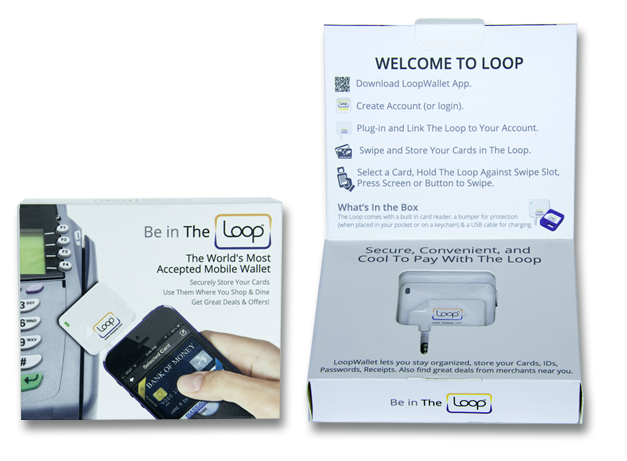
The Loop Fob Wallet AppCessory Packaging

Loop Wallet Set-Up

Once I downloaded the LoopWallet application from the iPhone store (Android version to be introduced shortly), I simply signed-up for the service and answered a series of security questions within the app. The securitization was complete after I entered an activation token that was sent to my connected email account.

Loading my cards was done using the card reading component of the fob while the fob was connected to my iPhone. A nice feature of the scanning process was the optional feature of adding a picture of my cards, the customer service phone numbers for for each card and an example of my signature. I could also add gift and loyalty cards as well as my drivers license to be part of my Loop Wallet. 

The last step of the initialization process was to designate a default card that would be used when the fob is disconnected from my phone (the majority of my transactions have been with the fob disconnected). The default card can be changed at any time when the fob is connected to the phone. The tutorial below was a great way to understand the application process and usage of the Loop Fob.

Wednesday, February 12, 2014

Tomorrow's Checking: Built For The Mobile-First Consumer

PRODUCT STRATEGIES


The checking account is the foundation of a customer relationship and has withstood the test of time even as electronic payments and debit cards have replaced checks, online banking has eliminated the need for paper statements and remote deposit capture has made a trip to the branch a rare occurrence.


But all that we have become accustomed to is about to change as we enter the era of the downloadable bank account.


The downloadable bank account differs from today's checking account because it is built specifically for Customer 3.0. This customer manages much of their life on the go from their smartphone, wants access to real-time information about their finances and wants the ability to transact business without checks or plastic. They are the type of customer who pays for their coffee with their Starbucks mobile app, and uses mobile deposit capture instead of going into the bank or credit union branch.

Tomorrow's checking is not just having mobile access to a traditional checking account. It is a bank account built for mobile.

It is a downloadable mobile banking application that provides the basic money storage and money management capabilities of today's checking as well as integrated payments, contextual insight and an overall customer experience not being provided by traditional financial institutions today. It is easy to open and manage using a mobile device, and is similar to the products offered by Moven, Simple GoBank, Bluebird in the U.S. and mBank, FidorHello, CommBank and Soon overseas. Tomorrow's checking may not have any associated plastic card, but may be able to store alternative currencies as was recently announced by Standard Bank.

Both Moven and Simple Provide Exceptional
Mobile Banking Contextual Insights

While the traditional checking account may not completely go away anytime soon, the risk of not meeting the needs of the mobile-first customer is increasing. This is because more new players are entering the marketplace such as T-Mobile's Mobile Money, with the potential of providing a downloadable bank account to a much broader audience than just the underbanked, unbanked and debanked. With either an already established physical presence or no bricks and mortar, these services can be provided at a lower cost than traditional banks.

Combining the attributes of a prepaid card and a traditional checking account, new checking disruptors can provide FDIC insurance, the ability to make direct deposits and electronic payments, accessibility to nationwide surcharge-free ATMs, mobile deposit capture and even branch access, checks and integrated rewards.

Attacking on a different front, players such as Google, PayPal, Amazon, Apple, Isis and others are hoping to control the digital wallet processing component of the payments ecosystem, leaving traditional banks with only depository functions.

Sunday, January 26, 2014

How Will Banks Respond if Apple Becomes Mobile Payments Player

MOBILE STRATEGIES

According to a report in the Wall Street Journal, Apple is gearing up to roll out a new payments system for physical goods and services beyond the walls of it's Apple stores.

If true, Apple would leverage the iTunes payments system, credit card data already on file for more than a half million consumers, and recent patents to become a big player overnight.

How will banks or credit unions respond? 


A new report claims that Apple’s senior vice president of Internet Software and Services, Eddy Cue, “has met with industry executives to discuss Apple’s interest in handling payments for physical goods and services on its devices, according to people familiar with the situation.” The paper also said that online store boss Jennifer Bailey has been re-assigned to a new role where she’s tasked with growing a payment service at Apple.

According to the Wall Street Journal, Apple also spoke to at least five other well-known executives in the payment industry about the position before tapping Ms. Bailey.

These moves come just months after Apple installed new iBeacon payments technology in their stores and allowed for the payment of smaller ticket store items using the iPhone app and without the need to interact with a store employee.

Obviously, if Apple does enter the mobile payments space, they would not be alone. Mobile payments is a highly competitive industry which has yet to develop a uniform standard due to the lack of tangible benefits to the consumer, the processor and the merchant. This hasn't deterred the likes of PayPal, Google, Square, Stripe, Visa, Mastercard and American Express from developing their own mobile payment platforms however.

While a solution from Apple may not require major changes from the customer or merchant as NFC or EMV does, Apple would still need to improve their position as a 'trusted payments partner' beyond what was found in a 2013 Oglivy and Mather's Mobile Shopper survey shown below.


Note: 'Trust' of Apple as a payments provider was much higher for current Apple customers and many consumers didn't view Apple as a payments player at the time of the research.

According to Denee Carrington, analyst at Forrester Research, "Apple is absolutely the sleeping giant in the payments world. They have the capability... they just haven't tied it all together."

Why Enter Mobile Payments


Why would Apple enter the mobile payments battlefield?

First of all, mobile payments is BIG business. According to Forrester Research, 31% of US online consumers who own a mobile phone are interested in or already use mobile payments for in-store purchases, up from 18% in 2011. However, while 61% of US consumers have heard of a digital wallet, only 11% use one.

But that is expected to change. Americans are expected to spend $90 billion through mobile payments by 2017, up from $12.8 billion in 2012, according to Forrester.

Secondly, current payments infrastructure is outdated. As can be seen from the recent data hacking done at Target, Neiman Marcus, Michael's and probably elsewhere, debit and credit cards are inherently insecure. And since most cards in the U.S. still use outdated magnetic stripes as opposed to EMV technology, personal data is relatively easy to steal.

Thirdly, each card in your wallet represents access to an account without real time insight or interface. A mobile-first payment application similar to what is offered by progressive financial institutions like Moven, Simple, and several banks overseas is a much better way to make payments. They allow you to see what is happening with your account in real time, provide instantaneous receipts, allow for interactive money management and have the potential to be more secure.

Lastly, similar to what banks do today, processing payments with a mobile device could enable Apple to charge a nominal processing fee, but more importantly, gather deep payments and behavioral data from customers and build even more brand loyalty.

Thursday, December 12, 2013

Loop: A Mobile Wallet Game Changer


Loop is an exciting new mobile wallet solution that has achieved near ubiquitous acceptance with more than 90% of POS terminals without any infrastructure change by the merchant, the acquirer, or the issuers. 


While other mobile wallet players are talking about NFC, EMV, barcodes, BLE and the cloud, Boston-based start-up Loop has invented an incredible mobile solution that intelligently communicates with the existing retail mag stripe reader interface today – without another plastic card and without the merchant needing to change anything!


Compared to the recently announced Coin solution that captured the hearts and more than 7M YouTube sets of eyes of consumers and the fintech world a few weeks ago (see Bank Marketing Strategy post on Coin), Loop has been amazingly under the payments 'next shiny object' radar during its funding process. There was a wave of fintech buzz in October, including several articles and a presentation at Money2020, but not much since.

In an exclusive interview with Will Graylin, CEO of LoopPay, Inc, he said, "Loop has been focused on product development and our soft launch which will take place in about 3 weeks. We did a small PR effort at the time of our Kickstarter campaign, but we did not want to blow a lot of hot air before we had our product ready for market and had happy users." He continued, "Many have overhyped their solution and have failed. We are more interested in the long run and are building solid a foundation for our future with solid partners."

Given that Loop is delivering a solution that automatically transforms virtually every existing POS terminal mag stripe reader into a contactless payment receiver, I don't expect Loop to be in the shadows much longer.

That's right, unlike other solutions that require merchant terminal conversion or a programmable card with limited security, memory, card or battery capacity, Loop integrates the highest level of Payment Card Industry (PCI) security and can store hundreds of payment, gift, loyalty, reward or ID cards into a smartphone.

To 'trick' the mag stripe reader into thinking a physical card is being swiped, the consumer will need one of several add on devices available from Loop to emulate the card swipe including a Fob (being sent to 2,000 pre-order customers and Kickstarter backers this month), smartphone charging cases (available for iPhone 5 and 5s in early 2014 and other devices shortly thereafter) and eventually wearable devices.

Once cards are 'swiped' into the LoopWallet app using the Square like device, the user can select the card they want to use at payments. While the process initially will use additional consumer hardware, ultimately, Loop would prefer that their Magnetic Secure Transmission (MST) technology be directly embedded into the mobile device itself, eliminating the need to carry any additional hardware.

Watch the video below and see if you agree with me that this is an ingenious new mobile payments innovation.


Subscribe to Bank Marketing Strategies

Tuesday, December 10, 2013

9 Strategies for Building a Great Mobile Banking App

There is no doubt that strategies around mobile banking are in the top five priorities for any financial institution. Even with this focus, many bankers have a difficult time making the paradigm shift that is required to build a great mobile banking application.


As a result, I asked Scott Bales, who is currently working on a new book entitled 'Mobile Ready' to share his thoughts on the keys to mobile app development success. 


Guest Post by Scott BalesRegional Director for strategic advisory firm User Strategy


The following thoughts come from the development of my new book, Mobile Ready and are provided to assist banks in driving greater success through the mobile platform. These come with a catch, however. To truly understand mobile, you have to accept that mobile is not the answer. Instead, there are real 'human' factors that create the foundation for mobile as a viable delivery tool for banks. 

What I am saying is that you should never embark on your mobile development for the sake of being on mobile. Doing so will only invite doubt, uncertainty and a constant struggle with the ROI of mobile. Instead, you need to view the interactions, engagement and loyalty that mobile can provide.

My list below is not intended to cover the technology aspects of mobile banking, like operating systems, security, transaction or payment capabilities. Instead, I have focused on preparing your mindset, so you can build a better mobile banking application from the perspective of your customer. 

After that, the technology components become much easier.


1. Get Out of the Building


Let's face it, banking interactions don't happen at your desk. Trying to craft an experience inside the office, you'll struggle to develop the necessary empathy for the customer, their context and their goals. The best mobile banking applications can't be built in an innovation lab. They need to be built with the input of real people who can validate your design assumptions and engagement potential in the real world.

You need to understand where and why people choose to engage your mobile application. Is it because they want to pay bills on their daily commute, do they need to check how much they have to spend before they go shopping.

Actively engage people in the context in which they need to engage your service, learn through open ended questions the behavioral, psychological and contextual needs of those moments. Only by connecting to the real world can you create truly delightful experiences.


2. Enlist Partners


So you think you know everything about building on mobile, or you're apprehensive to engage service providers. This is typical for most banks. The challenge for most banks is mobile banking applications built by bankers will look like banking on a phone . . . which can be boring, uninspiring and lacking creative thinking of new perspectives.

Engage open application designers, partners and thought leaders early in your journey to help leverage the successes from other industries to build a truly delightful mobile banking experience. Remind your teams that what you build will determine the consumer opinion of your brand over the coming year.

Digitally engaged consumers take experiences as material grounds for evaluating brands, and are less likely to be effected by your advertising messages. So make the effort to include a strong and diverse set of creative inputs into your creation process.

Monday, November 25, 2013

My Digital Banking Nirvana

Last week, I was fortunate enough to be one of the keynote speakers at the inaugural Next Bank Sydney. In preparation for my presentation entitled, 'My Digital Banking Nirvana', I looked globally for mobile banking applications that were the best at being simple, encouraging engagement and being contextual.


With help from the team at Mapa Research, I came up with almost 30 components for my perfect mobile banking relationship from every region of the world. Some were completely unique, while others were mobile applications that multiple financial institutions provide.


Link to my Next Bank Sydney presentation, My Digital Banking Nirvana on SlideShare here


What Makes a Great Mobile Banking Application


In many ways, there is no difference between what makes a great mobile banking application and what makes a great non-banking mobile application. The key components are:
        • Simplicity: Does the app replace a non-mobile process I do often? Does it make my daily life easier? Is it easy to use? In the non-banking world, I love the KeyRing application because it stores multiple loyalty cards in one place on my mobile phone, eliminating the need to carry plastic cards. The app also links to digital offers I can redeem without cutting coupons.
        • Engagement: Does the application stimulate positive interaction, and build a better application from this engagement? For me, my Marriott mobile application does a great job. Beyond providing the standard ability to make reservations and check my loyalty balances, it also allows me to check in early, receive notifications when my room is ready and informs me about special offers through multiple channels.
        • Contextual: One of the benefits of a mobile application vs. an online tool is the ability to provide value based on where I am located. My favorite app from a contextual perspective is OpenTable. Using locational functionality, OpenTable provides suggestions of restaurants based on my current location and previous dining experiences. Reward points are provided for using the app and starting next year, the app will also allow me to pay for my meal using my phone and the OpenTable application.
So, which mobile banking applications meet one or more of the above criteria and could become part of my digital banking nirvana? As could be expected, this list is fluid, since new innovations are being introduced every week, replacing previous applications that were once best-in-class.

Mobile Banking 'Basics'


As an active mobile banking user, there is some functionality that must be the foundation for my best-in-class mobile banking relationship. First of all, as covered in a recent blog post entitled, Banking Innovation for the Fat-Fingered, leveraging mobile imaging technology and my phone's photo capability simplifies mobile banking by removing keystrokes and improving accuracy. Therefore, I expect my future mobile bank to provide the following:

Friday, November 15, 2013

Big Day for Payments: Plastic vs. Digital

Only in the ever changing world of payments.


It is more than a bit ironic that on a day that Isis Mobile Wallet announced that they were going live with their carrier-backed digital payments initiative, a unique card-based solution named Coin announced their alternative solution to the overstuffed wallet.


The question is . . . which solution has the greatest chance for near-term and long-term success?


Maybe both will garner the support of the key involved parties. Maybe neither. Maybe another company will take the Coin concept mainstream sooner than the planned introduction. The one thing I am pretty sure of is that it is further evidence that financial institutions need to place multiple bets on alternative solutions to avoid being left behind.

Despite all of the talk in the industry around mobile payments, acceptance of new digital innovations and platforms has been anything but a smooth ride. In addition to the seemingly insurmountable challenge around consumer's concern with security/privacy, getting merchants, consumers, financial institutions and even carriers on the same page has been close to impossible.

At the end of the day, the biggest challenge may be the perception by many that there is no reason to fix something that isn't broken. The current card-based process for making payments, while not perfect, is relatively easy and definitely firmly entrenched in the consumer's daily life.

What is Coin?


Coin is a .84 mm thin plastic card-like device that can store any of your current cards (actually, 8 of them) and behave like the cards it replaces. Instead of carrying an assortment of debit, credit, gift, membership and loyalty cards from various institutions, you simply use the dongle provided (like the one used by merchants accepting Square) to capture your card information on your phone, take a picture of the cards and use the Coin app to load your Coin card.

While only 8 cards can be loaded into the Coin card, an unlimited number of cards can be stored in the mobile app and switched in and out of the card as desired. "You don't need eight cards every day, so your phone is kind of like your drawer, and your Coin is kind of like your wallet," explains Parashar, founder and CEO of Coin. 

When you are ready to pay or use a loaded card, simply press a button on your Coin card to select the card you want to use (electronics imbedded within the Coin card itself), present your card to the merchant like you have done in the past, and the rest of the process is the same as it is today (see compelling video below).


Coin is Secure


For those concerned about the security of the card should you leave the card behind (only happens to me about 4x a year), the Coin card uses Bluetooth low energy technology to inform you on your phone that you left your card behind. Better yet, the card completely disables itself if your phone and card are away from each other for more than 10 minutes. 

For those concerned about someone scanning another person's plastic into the app, Coin says that the app only accepts a card that includes the user's personal information. Further, the Coin app is protected with 128-bit or 256-bit encryption and the company is pursuing PCI compliance. The app is also password protected.

Wednesday, October 30, 2013

Mobile Payments Growth: Just The Tip of The Iceberg?

A new report from Business Insider Intelligence on the state of the mobile payments industry shows that, while the volume of mobile payment transactions still represent just a small percentage of overall payments on the surface, the level of growth is significant and quickly shaping the entire payments industry.


Both consumer and merchant uptake is exploding as smartphone users are quickly adopting mobile wallets, payment apps, etc. to facilitate offline and online purchases and as businesses are turning smartphones and tablets into full-featured POS terminals. The next critical step is to persuade the masses to become users of the payment technology available.


When Amazon and eBay launched their online shopping sites in 1995 and 1996 respectively, the notion that over half the U.S. population would make purchases online would have been scoffed at. Yet in 2013, the number of online shoppers in the U.S. will reach 189.6 million, according to eMarketer. In this case, the majority of the consumers were resistant to change until they made the switch and realized the benefits. The same applies to mobile payments.

The key is to examine the current payments industry growth trends, motivations of current users, the reasons for the gap between awareness and usage, and how financial institutions, retailers, network operators and equipment manufacturers can work together to convert reluctant consumers into loyal users. As mentioned by many of my fintech colleagues recently, it goes beyond a mentality of "If you build it, they will come". There is a need to solve for the concern around mobile security as well as develop incentives for usage.

Defining Mobile Payments


For the purpose of the study being reviewed, 'mobile payments' were defined as when a mobile, internet-connected device (smartphone, tablet, smart watch, Google Glass, etc.) is used to facilitate a transaction that might otherwise have taken place using a physical credit card, debit card, check or cash at a physical (not online) store. 'Mobile transactions' (for the purpose of this study) are a larger category that included mobile payments as well as mobile commerce and e-commerce channeled by an app or mobile website (e.g., Amazon's mobile app).

Mobile payments and transaction innovation is currently be led by start-ups and tech companies, who are prompting legacy payments players and card companies to reevaluate their current strategies and increase their own pace of innovation. 'Coopetition' has become the norm as companies team up with each other as opposed to building a mobile strategy from scratch. These partnerships (and individual initiatives) are pushing innovation forward quickly, making the industry fragmented yet ripe for consolidation.

Mobile Payments: Still Relatively Small on the Surface


Like an iceberg, there is much more to the mobile payments than what the can be seen on the surface today, with a U.S. mobile payments forecast of $30 billion in 2013. According to the research compiled by BI Intelligence, this forecast represents an average annual growth rate of 118 percent since 2008, but still will only account for 2 percent of the $3.3 trillion debit and credit card volume in the U.S. this year. It was also found that other global markets (such as Africa and the Asia Pacific regions) are seeing a much larger percentage of mobile transactions.

In both the U.S. and other global regions, the growth in mobile transaction volume has been driven primarily by the growth in smartphone adoption (especially in areas of underdeveloped banking systems). Not only has the smartphone impacted the consumer side of the payments equation, but also the merchant side, where attachable card readers transform smartphones and tablets into cash registers, making card purchases easier.

Monday, October 14, 2013

The Rise of PayPal as a Major Payments Player

No place in financial services is transformation and innovation more apparent than in the world of payments, where the convergence of mobile and new data-driven business models have the potential to completely disrupt both the consumer and merchant experience.


The recently concluded Money2020 illustrated that there is no shortage of payments players vying for attention,  but no firm seems to be as aggressive as the new PayPal, which continues to roll out new innovations impacting the payments ecosystem.


While some of the 'innovation' at PayPal may not seem new or disruptive (such as the use of QR codes), the ability to quickly build scale by using the existing payments infrastructure may be the key to PayPal's success. The company hopes to transform its reputation as a means of exchanging cash over the Internet into the default payment system for many everyday transactions.

At stake for PayPal is control of a mobile-payment market that is expected to grow more than three-fold from this year’s $235 billion over the next four years, according to researcher Gartner. PayPal faces a host of competitors, including Google Wallet, Square, Lemon and Stripe (and potentially Amazon and Apple).

Brian Roemmele, researcher and business advisor says of a recent PayPal announcement, "The true innovation that PayPal has achieved is really quite invisible and perhaps even boring to technologists. No iOS devices or android devices deployed at the merchant locations. No new add-ons needed, just the a boring laser bar code scanner that every single major retail store already has."

It is clear that PayPal is moving fast to become a ubiquitous option at retail merchants, introducing products for both the consumer and the retailer. In fact, there have been so many changes recently, it may be difficult to keep up.

To that end, I am providing a brief overview of what has occurred over only the past couple months and what the future may hold.


New PayPal Mobile App


In early September, Paypal introduced an updated version of the PayPal mobile app for both iOS and Android, turning it into much more of a mobile wallet. Maintaining all of the old features, the new app added tools to facilitate shopping and paying for goods online at the physical POS.


The app features five clearly labeled sections on the home page, with the major sources of innovation residing within the new Shop tab and Bill Me Later integration. Within the Shop screen, you can find nearby merchants that accept PayPal. Once you check in at a merchant (using your PIN), you can download any special offers from the store and can complete the transaction simply by saying "I'm paying with PayPal". Since the merchant will have your PayPal photo on their POS device or phone, funds can be transferred without needing to pull out your phone a second time.

Leveraging the app's location-based capabilities, there is the ability to push coupons based on a consumers specific location and even allow for ordering and paying for a meal within the app.

As for payments, PayPal is providing the option to pay directly from a bank account, from a PayPal balance or to use a credit card on file within the app. It's also expanded the 'Bill Me Later' function, providing credit for large purchases within the app. 

Wednesday, October 9, 2013

Money2020 Hump Day Tweet Highlights

Wednesday at Money2020 started very strong with an early morning tweet chat hosted by Bank of America and attended by over 200 fintech followers in a live chat room and digitally.


Participants provided feedback on the topics they enjoyed the most, the biggest takeaway, what the future shopper would look like and what it will take to make mobile payments mainstream. Despite the early hour, the twitter volume hit event highs based on tracking shown below.


Despite many people heading back home, the momentum for the day didn't stop, with keynotes from Facebook, Bank of America and First Data being a bridge to excellent 'Launchpad' sessions where new products were introduced each day in 6 minute intervals similar to Finovate.

Highlights of tweets made up until the lunch are provided below.


Tuesday Afternoon Tweets at Money2020 Combine Insightful & Snarky

After a very exciting morning of Money2020 new product announcements and visions for the future, it would be difficult to maintain the same energy level on Tuesday afternoon. 


As can be seen from the hashtag tracker below, #Money2020 tweets reached a crescendo during the opening keynotes, with more than 300 tweets during the 9:00(PT) hour.


Unfortunately, the other spike in tweets represented primarily snarky comments, as attendees became restless in expectation of a major announcement from the MCX panel than never occurred. This not uncommon at events like this, where a tone is set for the day and patience grows thin when all presentations don't deliver equally.


Even without the two major tweet spikes for the hashtag #Money2020, the discussion on twitter was robust throughout the day on Tuesday as it was on Monday. The combination of comments around megatrends as well as product insights made for interesting reading at the event as well as from afar. 


Tuesday, October 8, 2013

Tuesday Morning at Money2020 Filled With New Product Announcements

After an evening of fun at the Haze Nightclub, Money2020 kicked it into high gear on Tuesday with a series of industry updates and major product announcements from PayPalCitiMasterCardSquareAmerican ExpressEricssonDiscover and Amazon.


While not being at Money2020 in person, I have compiled the highlights of the day from tweets posted during the day from my fintech friends as I did at the end of Day One.


Note: Each of these tweets are 'live' allowing you to access, re-tweet, favorite, etc. Thanks to everyone for the great digital conversation that makes the event a worldwide gathering.


Monday, October 7, 2013

Monday at Money2020 in Tweets

Billed as the largest event focused on emerging payments and financial services, Money2020 has easily eclipsed its inaugural event in 2012, bringing together more than 4,000 fintech followers, including 300+ CEOs and more than 1,250 companies from 50 countries.


While not being able to attend this year, I was able to live vicariously through the tweets of others who captured the highlights (and some humor) from the first full day of the event. Below is a recap of today's sessions.


Wednesday, August 14, 2013

Today's Mobile Banking Apps: Table Stakes or Cutting Edge

There is no disputing that the U.S. mobile banking landscape is changing rapidly. Larger banks are setting the stage for broader market trends, while smaller banks (and even some regional players) play catch up in the development of new functionality.


What are some of the top U.S. banks doing that is innovative and what has quickly become table stakes in a game of mobile app one-upsmanship? And is mobile banking innovation becoming a value-added differentiator that can drive new revenues?


Over the past 18 months, mobile banking applications have evolved beyond the basics to include specialized functionalities, improved user experiences and an expansion of platforms supported. A year ago, mobile remote deposit capture (RDC) was live at only five of the top 13 banks. Today, it is a 'must have' banking application that has the potential to drive revenue. Similarly, P2P is now taking center stage at most banks despite some logistical hurdles, with five banks adding this functionality in the past 12 months.

How are banks keeping up with consumer demands? How are they keeping up with each other? What's next? In the third report in a series on the state of mobile banking released by the financial research and consulting firm Celent, a review of new application development is provided along with a glimpse into the future. 

In the 44-page report, The U.S. Mobile App Landscape: An Annual Evaluation of Mobile Banking at Top U.S. Banks, Celent found that larger banks tend to out-develop and out-adopt smaller institutions by a significant margin. “The channel is still relatively new, but leaders in the digital channel space are beginning to take offerings into the realm of value-added services that are context-sensitive, timely, and utilize big data", says Dan Latimore, senior vice president of Celent's Banking Group and coauthor of the report. "There’s a large disparity among digital offerings—industry leaders are light-years ahead of the laggards.”

Below is Celent's view of the mobile landscape as it continues to evolve. As can be seen, Emerging Capabilities include a more advanced stage of interaction with more knowledge-driven tools and analytics. While some of these may not be pursued by every organization, Celent believes most will be tomorrow's standard. Interestingly, some of the functionality in the Future Focus is already being implemented on a global basis (see previous post 'Banks Accelerate Mobile Banking Innovation', June 2013). 

While the future may be considered speculative, some components are beginning to appear at the more progressive institutions (U.S. Bank and BBVA Photo Bill Pay) and at some of the new players such as Moven, Simple, GoBank and BlueBird (see 'Challenger Brands & Disruptive Ideas: Learning From The NeoBanks', Financial Brand, August 2013).


Current Evolution of Mobile (Celent, June 2013)

Sunday, July 14, 2013

Understanding the Mobile Banking Consumer

In order to unlock the vast potential of mobile banking, banks and credit unions must better understand mobile banking preferences of current users while alleviating the fears and lack of understanding of non-users. Broadly speaking, while convenience is the primary benefit cited by mobile banking customers, security fears remain the number one barrier to mobile banking growth.


As opposed to a 'one-size-fits-all' approach, financial institutions should consider segmenting the mobile banking universe for improved resource allocation and to optimize customer acquisition, utilization, retention and differentiation.


Mobile devices, including smartphones and tablets continue to transform the way consumers bank, budget, make payments and shop. In fact, having a mobile banking offering is now considered 'table stakes' to consumers when selecting a financial institution. According to the 2013 Federal Reserve Consumers and Mobile Financial Services Report:

      • 87% of the U.S. adult population has a mobile phone
      • 52% of the mobile phones are smartphones (internet-enabled)
      • 87% of smartphone users access the internet regularly (in the past week)
      • 28% of mobile phone users have used mobile banking over past 12 months
      • 48% of smartphone users have used mobile banking in past 12 months

While some financial institutions may be satisfied with this level of acceptance, mobile banking leaders understand that checking balances using a phone is not 'full engagement' and that growth of use beyond this level will require a better understanding of the mobile customer base and the barriers that keep non-users from using mobile banking. Banks and credit unions also realize how important this understanding will be as they try to optimize channels, reduce operating costs and identify new revenue sources.

According to a new report just released by Monitise and Cognizant entitled, 'Segment-Based Strategies for Mobile Banking', financial institutions need to better understand the mobile banking customer universe and may want to consider segmenting their customers based on mobile adoption, desired features and benefits, mobile devices and monetization potential. By segmenting the mobile customer base, the following questions could be answered:

      • What is the best way to segment the mobile customer base?
      • How do mobile adoption levels vary across consumer segments?
      • What mobile banking features and applications are preferred and by whom?
      • How do tablet users differ from smartphone users?
      • What opportunities exist for further monetization?
      • How can the mobile channel be leveraged for differentiation?

Understanding the Mobile Banking Consumer


Despite all of the industry discussion around the importance and growth of mobile banking, adoption levels still only average 33% across all segments and age categories. While younger, wealthier and more tech-savvy consumers are more engaged with the mobile channel, the challenge is to replicate these higher adoption levels with other segments.

Mobile Banking Adoption Across Age and Income Parameters
As can be seen above, the highest adoption rate for mobile banking is in the 25-34 age bracket with annual income above $75,000. Mobile banking is accessed primarily through mobile phones (32 percent) and tablets (7 percent), with 24 percent using both devices. As can be expected, the majority of consumers prefer smartphone and tablet apps as opposed to mobile banking web sites to access their accounts. The very oldest segment prefers text banking.
