Showing posts with label mobile payments. Show all posts

Monday, February 17, 2014

Payments Innovations Replace Debit and Credit Cards

PAYMENTS STRATEGY


At a time when payment innovation seems like an everyday occurrence, it is exciting when new ideas come along that embrace both mobility and simplicity. In separate personal user tests, LoopPay allows me to make contactless payments at virtually every retail point-of-sale terminal while Square Cash enables me to collect money from friends with an email.


Here's why I no longer need a wallet filled with plastic.


When I initially covered these payments innovations in late 2013, both LoopPay and Square Cash drew my attention because of their unique strategies to impact the way people make payments. LoopPay promised to deliver a device that would 'trick' a traditional POS terminal into thinking a card was being used, making virtually every transaction contactless. Square Cash provided a secure method of making P2P payments via email. LoopPay's value proposition was to provide an easier and more secure way to pay merchants while Square Cash aimed to simplify P2P transactions.

Loop Wallet


Several weeks ago, I received my Loop Fob, the first in a series of Loop Wallet 'AppCessories' that would allow me to securely store and organize my payment, loyalty and gift cards in my iPhone while making contactless payments at more than 90% of today's terminals worldwide.

My first impression when I received my Loop Fob was that, while the packaging was very well done and provided a clear overview of what was needed to use the device, the device was larger than I anticipated. Once I began to use the device, however, I found the fob to be convenient while serving to whet my appetite for the soon to be released iPhone ChargeCase.
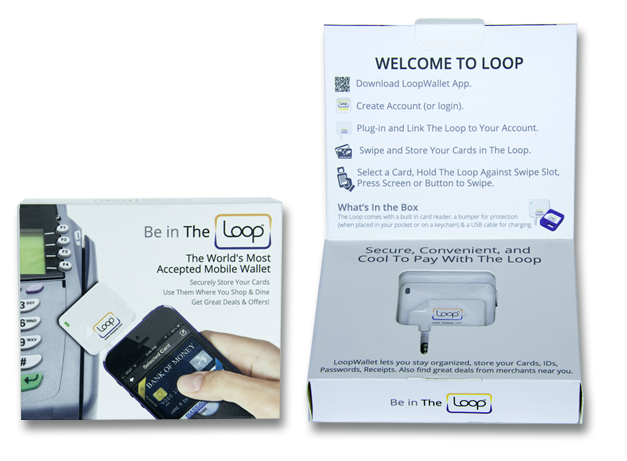
The Loop Fob Wallet AppCessory Packaging

Loop Wallet Set-Up

Once I downloaded the LoopWallet application from the iPhone store (Android version to be introduced shortly), I simply signed-up for the service and answered a series of security questions within the app. The securitization was complete after I entered an activation token that was sent to my connected email account.

Loading my cards was done using the card reading component of the fob while the fob was connected to my iPhone. A nice feature of the scanning process was the optional feature of adding a picture of my cards, the customer service phone numbers for for each card and an example of my signature. I could also add gift and loyalty cards as well as my drivers license to be part of my Loop Wallet. 

The last step of the initialization process was to designate a default card that would be used when the fob is disconnected from my phone (the majority of my transactions have been with the fob disconnected). The default card can be changed at any time when the fob is connected to the phone. The tutorial below was a great way to understand the application process and usage of the Loop Fob.

Sunday, January 26, 2014

How Will Banks Respond if Apple Becomes Mobile Payments Player

MOBILE STRATEGIES

According to a report in the Wall Street Journal, Apple is gearing up to roll out a new payments system for physical goods and services beyond the walls of it's Apple stores.

If true, Apple would leverage the iTunes payments system, credit card data already on file for more than a half million consumers, and recent patents to become a big player overnight.

How will banks or credit unions respond? 


A new report claims that Apple’s senior vice president of Internet Software and Services, Eddy Cue, “has met with industry executives to discuss Apple’s interest in handling payments for physical goods and services on its devices, according to people familiar with the situation.” The paper also said that online store boss Jennifer Bailey has been re-assigned to a new role where she’s tasked with growing a payment service at Apple.

According to the Wall Street Journal, Apple also spoke to at least five other well-known executives in the payment industry about the position before tapping Ms. Bailey.

These moves come just months after Apple installed new iBeacon payments technology in their stores and allowed for the payment of smaller ticket store items using the iPhone app and without the need to interact with a store employee.

Obviously, if Apple does enter the mobile payments space, they would not be alone. Mobile payments is a highly competitive industry which has yet to develop a uniform standard due to the lack of tangible benefits to the consumer, the processor and the merchant. This hasn't deterred the likes of PayPal, Google, Square, Stripe, Visa, Mastercard and American Express from developing their own mobile payment platforms however.

While a solution from Apple may not require major changes from the customer or merchant as NFC or EMV does, Apple would still need to improve their position as a 'trusted payments partner' beyond what was found in a 2013 Oglivy and Mather's Mobile Shopper survey shown below.


Note: 'Trust' of Apple as a payments provider was much higher for current Apple customers and many consumers didn't view Apple as a payments player at the time of the research.

According to Denee Carrington, analyst at Forrester Research, "Apple is absolutely the sleeping giant in the payments world. They have the capability... they just haven't tied it all together."

Why Enter Mobile Payments


Why would Apple enter the mobile payments battlefield?

First of all, mobile payments is BIG business. According to Forrester Research, 31% of US online consumers who own a mobile phone are interested in or already use mobile payments for in-store purchases, up from 18% in 2011. However, while 61% of US consumers have heard of a digital wallet, only 11% use one.

But that is expected to change. Americans are expected to spend $90 billion through mobile payments by 2017, up from $12.8 billion in 2012, according to Forrester.

Secondly, current payments infrastructure is outdated. As can be seen from the recent data hacking done at Target, Neiman Marcus, Michael's and probably elsewhere, debit and credit cards are inherently insecure. And since most cards in the U.S. still use outdated magnetic stripes as opposed to EMV technology, personal data is relatively easy to steal.

Thirdly, each card in your wallet represents access to an account without real time insight or interface. A mobile-first payment application similar to what is offered by progressive financial institutions like Moven, Simple, and several banks overseas is a much better way to make payments. They allow you to see what is happening with your account in real time, provide instantaneous receipts, allow for interactive money management and have the potential to be more secure.

Lastly, similar to what banks do today, processing payments with a mobile device could enable Apple to charge a nominal processing fee, but more importantly, gather deep payments and behavioral data from customers and build even more brand loyalty.

Wednesday, January 22, 2014

7 Reasons Mobile Money From T-Mobile Should Worry Bankers

MOBILE STRATEGIES


The cellular company that promised to shake up the wireless industry, has now disrupted the banking industry by introducing a free way for customers (and non-customers) to keep money in a checking account, make direct and mobile deposits, pay bills and get fee-free ATM access to cash with a Visa debit card.


Not to be mistaken for the future Isis mobile wallet (backed by AT&T, Verizon and others), the T-Mobile Mobile Money solution is the latest in a wave of neobank competitors such as Simple, Moven, GoBank and Amex's Serve. The major difference is that this offering comes with a vast distribution network, an established customer base, significant marketing muscle and more.


When I heard about this newest banking solution, I immediately imagined the buzz in the halls of banks and credit unions across the country. Some financial executives would be acting like it is the end of the world as we knew it, while others would immediately fall into the trap of saying, "It's no big deal". The reality is probably somewhere in between. But there is cause for concern. 

While this is not the same as turning smartphones into mobile wallets, it is a solution offered by a wireless provider that has distinct advantages over traditional banks and credit unions. I would also caution those who see this as "just a solution for the 'underbanked' (definition still under discussion)". I think it could be much more. 

In fact, in some parts of the world, mobile phones have become the de facto way for people to handle day-to-day financial transactions (as opposed to banks). The best known example would probably be Kenya’s M-PESA which is currently used by 20 million people and includes loans and savings products.

So, why should Mobile Money from T-Mobile worry U.S. bankers (in no particular order) . . ?


1. T-Mobile Has an Established Customer Base


Unlike the majority of previous neobank entrants in the market, T-Mobile already has an established customer base to draw from. T-Mobile US provides services through its subsidiaries and operates its flagship brands, T-Mobile and MetroPCS, serving approximately 46.7 million wireless subscribers (Bank of America has 55 million customers).

T-Mobile also isn't new to the personal finance arena. By separating the costs of wireless services and devices, T-Mobile already provides customers the option of financing smartphone purchases. According to T-Mobile, they have facilitated billions of dollars in loans for customer phones (all without charging a penny in interest).

"One of the main reasons we're doing this is to deepen our relationship with our customers," said T-Mobile marketing executive Andrew Sherrard.

T-Mobile's cellular pricing strategy (cheap and with no contracts) should correlate well with the demographics they are initially trying to reach. While there are definitely mass affluent and affluent customers who use T-Mobile phones, an above average segment of their customer base probably includes customers without access to traditional financial services and who are looking for lower prices.

Notice in the website marketing, that the term 'prepaid debit card' is deemphasized in exchange for references to a checking account.

Source: T-Mobile Customer Mobile Money Web Page

Thursday, December 12, 2013

Loop: A Mobile Wallet Game Changer


Loop is an exciting new mobile wallet solution that has achieved near ubiquitous acceptance with more than 90% of POS terminals without any infrastructure change by the merchant, the acquirer, or the issuers. 


While other mobile wallet players are talking about NFC, EMV, barcodes, BLE and the cloud, Boston-based start-up Loop has invented an incredible mobile solution that intelligently communicates with the existing retail mag stripe reader interface today – without another plastic card and without the merchant needing to change anything!


Compared to the recently announced Coin solution that captured the hearts and more than 7M YouTube sets of eyes of consumers and the fintech world a few weeks ago (see Bank Marketing Strategy post on Coin), Loop has been amazingly under the payments 'next shiny object' radar during its funding process. There was a wave of fintech buzz in October, including several articles and a presentation at Money2020, but not much since.

In an exclusive interview with Will Graylin, CEO of LoopPay, Inc, he said, "Loop has been focused on product development and our soft launch which will take place in about 3 weeks. We did a small PR effort at the time of our Kickstarter campaign, but we did not want to blow a lot of hot air before we had our product ready for market and had happy users." He continued, "Many have overhyped their solution and have failed. We are more interested in the long run and are building solid a foundation for our future with solid partners."

Given that Loop is delivering a solution that automatically transforms virtually every existing POS terminal mag stripe reader into a contactless payment receiver, I don't expect Loop to be in the shadows much longer.

That's right, unlike other solutions that require merchant terminal conversion or a programmable card with limited security, memory, card or battery capacity, Loop integrates the highest level of Payment Card Industry (PCI) security and can store hundreds of payment, gift, loyalty, reward or ID cards into a smartphone.

To 'trick' the mag stripe reader into thinking a physical card is being swiped, the consumer will need one of several add on devices available from Loop to emulate the card swipe including a Fob (being sent to 2,000 pre-order customers and Kickstarter backers this month), smartphone charging cases (available for iPhone 5 and 5s in early 2014 and other devices shortly thereafter) and eventually wearable devices.

Once cards are 'swiped' into the LoopWallet app using the Square like device, the user can select the card they want to use at payments. While the process initially will use additional consumer hardware, ultimately, Loop would prefer that their Magnetic Secure Transmission (MST) technology be directly embedded into the mobile device itself, eliminating the need to carry any additional hardware.

Watch the video below and see if you agree with me that this is an ingenious new mobile payments innovation.


Subscribe to Bank Marketing Strategies

Monday, November 25, 2013

My Digital Banking Nirvana

Last week, I was fortunate enough to be one of the keynote speakers at the inaugural Next Bank Sydney. In preparation for my presentation entitled, 'My Digital Banking Nirvana', I looked globally for mobile banking applications that were the best at being simple, encouraging engagement and being contextual.


With help from the team at Mapa Research, I came up with almost 30 components for my perfect mobile banking relationship from every region of the world. Some were completely unique, while others were mobile applications that multiple financial institutions provide.


Link to my Next Bank Sydney presentation, My Digital Banking Nirvana on SlideShare here


What Makes a Great Mobile Banking Application


In many ways, there is no difference between what makes a great mobile banking application and what makes a great non-banking mobile application. The key components are:
        • Simplicity: Does the app replace a non-mobile process I do often? Does it make my daily life easier? Is it easy to use? In the non-banking world, I love the KeyRing application because it stores multiple loyalty cards in one place on my mobile phone, eliminating the need to carry plastic cards. The app also links to digital offers I can redeem without cutting coupons.
        • Engagement: Does the application stimulate positive interaction, and build a better application from this engagement? For me, my Marriott mobile application does a great job. Beyond providing the standard ability to make reservations and check my loyalty balances, it also allows me to check in early, receive notifications when my room is ready and informs me about special offers through multiple channels.
        • Contextual: One of the benefits of a mobile application vs. an online tool is the ability to provide value based on where I am located. My favorite app from a contextual perspective is OpenTable. Using locational functionality, OpenTable provides suggestions of restaurants based on my current location and previous dining experiences. Reward points are provided for using the app and starting next year, the app will also allow me to pay for my meal using my phone and the OpenTable application.
So, which mobile banking applications meet one or more of the above criteria and could become part of my digital banking nirvana? As could be expected, this list is fluid, since new innovations are being introduced every week, replacing previous applications that were once best-in-class.

Mobile Banking 'Basics'


As an active mobile banking user, there is some functionality that must be the foundation for my best-in-class mobile banking relationship. First of all, as covered in a recent blog post entitled, Banking Innovation for the Fat-Fingered, leveraging mobile imaging technology and my phone's photo capability simplifies mobile banking by removing keystrokes and improving accuracy. Therefore, I expect my future mobile bank to provide the following:

Friday, November 15, 2013

Big Day for Payments: Plastic vs. Digital

Only in the ever changing world of payments.


It is more than a bit ironic that on a day that Isis Mobile Wallet announced that they were going live with their carrier-backed digital payments initiative, a unique card-based solution named Coin announced their alternative solution to the overstuffed wallet.


The question is . . . which solution has the greatest chance for near-term and long-term success?


Maybe both will garner the support of the key involved parties. Maybe neither. Maybe another company will take the Coin concept mainstream sooner than the planned introduction. The one thing I am pretty sure of is that it is further evidence that financial institutions need to place multiple bets on alternative solutions to avoid being left behind.

Despite all of the talk in the industry around mobile payments, acceptance of new digital innovations and platforms has been anything but a smooth ride. In addition to the seemingly insurmountable challenge around consumer's concern with security/privacy, getting merchants, consumers, financial institutions and even carriers on the same page has been close to impossible.

At the end of the day, the biggest challenge may be the perception by many that there is no reason to fix something that isn't broken. The current card-based process for making payments, while not perfect, is relatively easy and definitely firmly entrenched in the consumer's daily life.

What is Coin?


Coin is a .84 mm thin plastic card-like device that can store any of your current cards (actually, 8 of them) and behave like the cards it replaces. Instead of carrying an assortment of debit, credit, gift, membership and loyalty cards from various institutions, you simply use the dongle provided (like the one used by merchants accepting Square) to capture your card information on your phone, take a picture of the cards and use the Coin app to load your Coin card.

While only 8 cards can be loaded into the Coin card, an unlimited number of cards can be stored in the mobile app and switched in and out of the card as desired. "You don't need eight cards every day, so your phone is kind of like your drawer, and your Coin is kind of like your wallet," explains Parashar, founder and CEO of Coin. 

When you are ready to pay or use a loaded card, simply press a button on your Coin card to select the card you want to use (electronics imbedded within the Coin card itself), present your card to the merchant like you have done in the past, and the rest of the process is the same as it is today (see compelling video below).


Coin is Secure


For those concerned about the security of the card should you leave the card behind (only happens to me about 4x a year), the Coin card uses Bluetooth low energy technology to inform you on your phone that you left your card behind. Better yet, the card completely disables itself if your phone and card are away from each other for more than 10 minutes. 

For those concerned about someone scanning another person's plastic into the app, Coin says that the app only accepts a card that includes the user's personal information. Further, the Coin app is protected with 128-bit or 256-bit encryption and the company is pursuing PCI compliance. The app is also password protected.

Tuesday, November 5, 2013

Banking Innovation For The Fat-Fingered

Financial services innovation takes many forms, but Mitek Systems believes simplifying a customer's banking life is best. A leader in the category of using the smartphone camera to simplify normally complex processes, Mitek's mobile deposit solution set the stage five years ago for innovations to follow.


Since 2008, Mitek has had a laser focus and a broad passion for using the phone's photo capability to eliminate the keystrokes that are the bane of consumers in a hurry, who are spelling challenged or have a hard time using oversized fingers on an undersized keypad.


As I have written about frequently over the past several months, I believe some of the best innovations in banking are not the result of added features and benefits to existing financial products and services, but the simplification of everyday processes that can improve the lives of a banking customer. This is what makes me such a fan of Mitek. 

Mitek has created solutions that allow customers to use the camera on their smartphone and tablets to deposit checks and reload prepaid cards, pay bills, get insurance quotes, open new accounts and transfer balances . . . all with a snap of a picture. No data entry is required. With mobile imaging technology, the image is captured with error correction and adjustments made, then data is extracted and put into pre-set fields on the mobile banking app instantly.

What is interesting when I watch Mitek and their bank and credit union partners is that every time I think there is no more that my phone's camera can do, Mitek finds a new solution or enhances a previous innovation.

In an industry where the growth of mobile banking is mirroring the growth in smartphone ownership, the benefits of using one of the most easily understood functions of a smartphone and leveraging it to facilitate a better mobile banking experience are enormous. These capabilities can attract new customer, build engagement, increase cross-selling and enhance loyalty.

While what may follow may sound like a commercial for Mitek, it probably is. With so little true innovation being done by traditional banking organizations in the U.S., it is refreshing to see a company that makes innovation part of their overarching company mantra. The good news is that Mitek continues to build new solutions that banks can implement quickly and easily (i.e. U.S. Bank), making them innovators as well.

To illustrate my point about the focus of Mitek on innovation, I have included a video where Jim DeBello, president and CEO of Mitek discusses innovation at his company.


Wednesday, October 30, 2013

Mobile Payments Growth: Just The Tip of The Iceberg?

A new report from Business Insider Intelligence on the state of the mobile payments industry shows that, while the volume of mobile payment transactions still represent just a small percentage of overall payments on the surface, the level of growth is significant and quickly shaping the entire payments industry.


Both consumer and merchant uptake is exploding as smartphone users are quickly adopting mobile wallets, payment apps, etc. to facilitate offline and online purchases and as businesses are turning smartphones and tablets into full-featured POS terminals. The next critical step is to persuade the masses to become users of the payment technology available.


When Amazon and eBay launched their online shopping sites in 1995 and 1996 respectively, the notion that over half the U.S. population would make purchases online would have been scoffed at. Yet in 2013, the number of online shoppers in the U.S. will reach 189.6 million, according to eMarketer. In this case, the majority of the consumers were resistant to change until they made the switch and realized the benefits. The same applies to mobile payments.

The key is to examine the current payments industry growth trends, motivations of current users, the reasons for the gap between awareness and usage, and how financial institutions, retailers, network operators and equipment manufacturers can work together to convert reluctant consumers into loyal users. As mentioned by many of my fintech colleagues recently, it goes beyond a mentality of "If you build it, they will come". There is a need to solve for the concern around mobile security as well as develop incentives for usage.

Defining Mobile Payments


For the purpose of the study being reviewed, 'mobile payments' were defined as when a mobile, internet-connected device (smartphone, tablet, smart watch, Google Glass, etc.) is used to facilitate a transaction that might otherwise have taken place using a physical credit card, debit card, check or cash at a physical (not online) store. 'Mobile transactions' (for the purpose of this study) are a larger category that included mobile payments as well as mobile commerce and e-commerce channeled by an app or mobile website (e.g., Amazon's mobile app).

Mobile payments and transaction innovation is currently be led by start-ups and tech companies, who are prompting legacy payments players and card companies to reevaluate their current strategies and increase their own pace of innovation. 'Coopetition' has become the norm as companies team up with each other as opposed to building a mobile strategy from scratch. These partnerships (and individual initiatives) are pushing innovation forward quickly, making the industry fragmented yet ripe for consolidation.

Mobile Payments: Still Relatively Small on the Surface


Like an iceberg, there is much more to the mobile payments than what the can be seen on the surface today, with a U.S. mobile payments forecast of $30 billion in 2013. According to the research compiled by BI Intelligence, this forecast represents an average annual growth rate of 118 percent since 2008, but still will only account for 2 percent of the $3.3 trillion debit and credit card volume in the U.S. this year. It was also found that other global markets (such as Africa and the Asia Pacific regions) are seeing a much larger percentage of mobile transactions.

In both the U.S. and other global regions, the growth in mobile transaction volume has been driven primarily by the growth in smartphone adoption (especially in areas of underdeveloped banking systems). Not only has the smartphone impacted the consumer side of the payments equation, but also the merchant side, where attachable card readers transform smartphones and tablets into cash registers, making card purchases easier.
